In advanced cosmetic formulation, the selection of humectants and solvents goes far beyond basic hydration. Their impact is decisive in formula stability, skin biocompatibility and the optimisation of the preservative system, directly influencing texture, skin comfort, tolerance and the overall quality perception experienced by the end consumer.
BIOBLANCA® (1,3-propanediol) — developed by AHB and exclusively distributed by Emsa Tecnología Química — represents a new generation of bio-based humectants. Its superiority over conventional glycols is supported by extensive comparative studies confirming its performance and versatility.
Biotechnological origin
BIOBLANCA® 1,3-propanediol is obtained through the biological fermentation of renewable raw materials, allowing the replacement of petrochemical-derived polyols. This process not only preserves the integrity of the formulation but also enhances the technical performance and purity of the final product.
The product features a 100% bio-based origin, a controlled biotechnological process, and COSMOS Approved certification.
Moisturising performance: comparative results
Skin hydration tests carried out by AHB compared the performance of 1,3-propanediol with other polyols commonly used in cosmetics, such as propylene glycol.
Results obtained:
-
Higher increase in skin hydration compared to propylene glycol and other humectants.
-
Better performance during the first 5–30 minutes after application
-
Greater water retention capacity on the skin surface
The studies conducted by AHB demonstrate that 1,3-propanediol significantly improves both hydration levels and the sensory profile of cosmetic formulations.
When combined with glycerin, 1,3-propanediol acts as a performance enhancer, optimising hydration while improving the sensory feel of the formulation.
-
1,3-Propanediol at 10% showed superior initial hydration performance.
-
The combination of 1,3-propanediol and glycerin improved hydration while reducing tackiness.
-
Clear improvement in sensory profile compared to glycerin alone.
-
Thanks to its differentiated polarity, 1,3-propanediol expands the solubility range of the formulation system.
-
It helps prevent the crystallisation or precipitation of actives that are not fully stabilised in glycerin alone.
-
It facilitates the incorporation of extracts, vitamins and organic acids, contributing to more stable and versatile formulations.
Relevance of sensory profile in consumer perception
Several industry studies agree that product sensorially is a key factor in perceived quality and repurchase intent within the cosmetic market. Texture, skin feel after application and absorption speed directly influence the user experience and the overall evaluation of the product.
Along the same lines, the State of Beauty 2025 report by McKinsey & Company highlights that today’s consumer places increasing importance on perceived value, with texture, skin comfort and user experience being decisive factors in purchasing decisions, particularly in facial care and leave-on products.
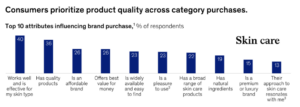
Think about the brand per category you buy the most. Which of the following attributes best describes why you buy it the most? – McKinsey Global Beauty Consumer Survey, Feb 2025 (n = 3,600–3,700 per category)
Preservation system boosting
One of the most relevant aspects observed in technical studies is the ability of 1,3-propanediol to enhance the effectiveness of the preservative system.
Microbiological challenge test (7 days):
Formulations containing 1,3-propanediol showed:
-
Reduction of microbial load to < 10 CFU
-
Improved performance against Escherichia coli, Staphylococcus aureus, Candida albicans and Aspergillus niger
Compared to other polyols, 1,3-propanediol demonstrated superior performance to 1,3-butanediol, allowing for the optimisation of conventional preservative levels such as phenoxyethanol or ethylhexylglycerin.
This effect is associated with its influence on water activity and its excellent compatibility with commonly used preservation systems.
Formulation stability
Stability tests carried out under thermal cycling conditions (25 °C / –18 °C) showed that:
-
Formulations containing 1,3-propanediol exhibit greater stability
-
Reduced phase separation
-
Improved homogeneity after stress cycles
-
Superior performance compared to propylene glycol and 2,3-butanediol
These results confirm its contribution to the physicochemical robustness of cosmetic formulations.
Safety and skin tolerance
Skin and eye irritation studies indicate:
-
No irritation even at concentrations up to 75%
-
Good dermal tolerance
-
Negative results in sensitisation tests
-
Ocular irritation index (HET-CAM) < 1 → non-irritating
This safety profile allows its use in:
-
Facial care products
-
Baby and children’s cosmetics
-
Tear-free formulations
-
Products for sensitive skin
Applications in cosmetic formulation
Thanks to its technical profile, BIOBLANCA® 1,3-propanediol can be used in:
-
Facial creams and emulsions
-
Serums and essences
-
Cleansing products
-
Hair care formulations
-
Sunscreens
-
High-tolerance formulations
Its versatility makes it a cross-functional ingredient within modern cosmetic development.
All of this enables the creation of more efficient, safer formulations that are fully aligned with current sustainability standards and technical quality requirements.
Discover the full product datasheet and its applications here.
* The data presented in this article are based on technical studies and comparative tests carried out by AHB, manufacturer of BIOBLANCA® 1,3-propanediol, under controlled laboratory conditions.
Let’s talk?
 Carles Puig