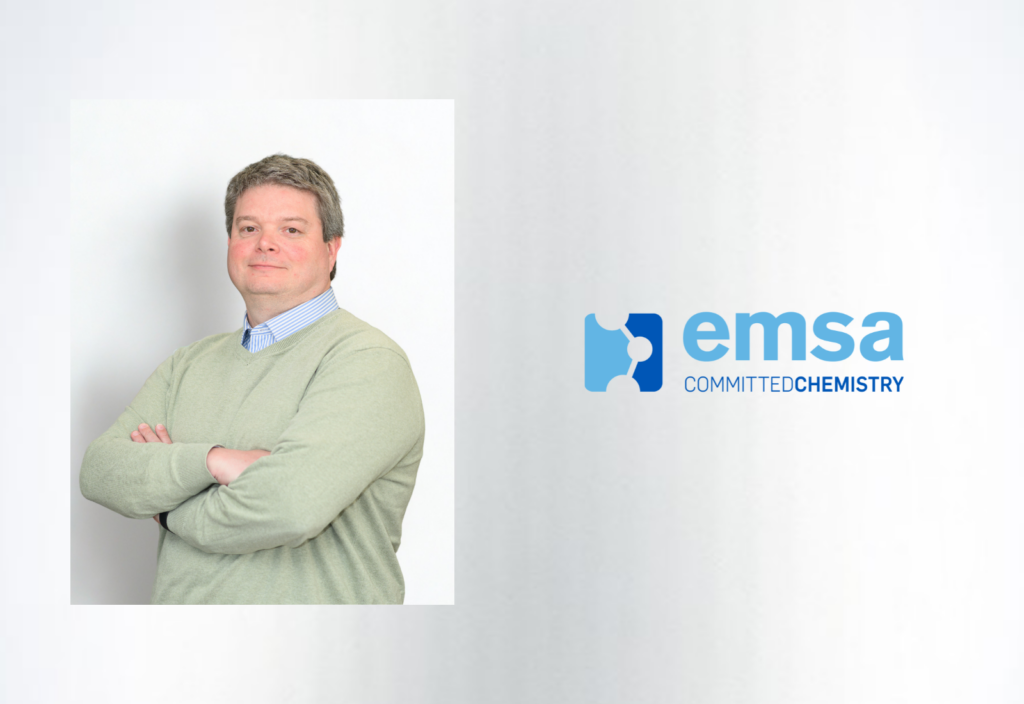
Today, we speak with Xavier Vidal, the new Operations and Logistics Director at Emsa Tecnología Química.
Improving operations where things really happen

Xavier holds a degree in Business Studies from the University of Barcelona, with a specialization in Industrial Production, and is a Lean Six Sigma Black Belt. He brings more than 20 years of experience in logistics, operatio and supply chain across industrial and international environments.
Throughout his career, he has worked with a clear objective: understanding how processes really work in order to make them simpler, more reliable, and more efficient. An approach where data is essential, but so are the people behind every operation.
In this interview, Xavier talks about joining Emsa, his approach to continuous improvement, and a way of working based on proximity, trust, and finding solutions that work in practice.
What attracted you to the company?
“I saw Emsa as a company with a very clear direction and mature, well-defined, and thoroughly analyzed processes and standards. At the same time, I was interested in understanding how consistently all of this translated into day-to-day operations.
That was precisely what attracted me most: the opportunity to bring that vision closer to operational reality, identify where deviations occur, and work alongside the teams to turn them into opportunities for improvement.”
How would you describe your working style in one sentence?
“Practical, approachable, and focused on improvement: understand the problem first, simplify it, and then make things work.”
What’s the first thing you say when someone asks, “What do you do?”
“Lately, I’ve been saying that I try to make work easier and problems less frequent. In practice, that means working alongside teams, analyzing how we do things, and looking for simpler, more reliable, and more efficient ways of doing them.
Ultimately, improving a process often isn’t about making it more complicated, but quite the opposite.”
What tool or habit is essential in your daily routine?
“Talking to the people who actually do the work and then comparing that reality with the data. You can learn a lot from looking at an Excel spreadsheet, but you usually understand a problem properly when you go to where things are happening, observe, and ask questions.
Although, to be fair, I probably have an Excel spreadsheet open too. 😄”
What do you value most about the team you work with?
“Trust and the ability to speak openly. I like teams where people can say, ‘this isn’t working’ without looking for someone to blame, and use that as a starting point to find a solution together.
I also really value autonomy. I believe that when everyone understands their responsibilities and has the ability to make decisions, teams work better and problems can be solved much more efficiently.”
Is there a hobby or activity that helps you switch off from work?
“I enjoy walking, spending time with my family, and playing board games. They’re great ways to completely switch gears, disconnect from the pace of everyday work, and leave processes, KPIs, and, of course, Excel spreadsheets behind for a while.”
Is there a book, film, or series you would recommend to the team?
“I would recommend Turn the Ship Around!, by L. David Marquet. It tells the true story of the USS Santa Fe, which went from being one of the lowest-performing submarines in the U.S. Navy to becoming a benchmark for performance.
It all begins when Marquet gives an order that is impossible to carry out and discovers that the crew tries to follow it anyway, simply because the captain gave the order. From that moment on, he completely changes his approach to leadership.
I find it particularly interesting because it explores concepts such as autonomy, responsibility, and trust within a nuclear submarine — probably one of the most hierarchical and demanding environments imaginable.”
We will continue sharing new voices from our team, because we believe that committed chemistry starts with people.